
Odoo in 2026: How this ERP became the backbone of companies looking to grow with control
In this blog, you'll learn why Odoo has become a key platform for companies in 2026. You will discover how it helps to integrate processes, improve efficiency, have greater control over the operation and facilitate decision-making, allowing organizations to grow in an orderly manner and adapt to new market demands.

For a long time, ERP systems were synonymous with long, expensive and inflexible projects. For many companies, implementing an ERP involved months or years of work, heavy initial investments, and the constant feeling that the system dictated the way they operated, rather than adapted to the business. In 2026, this paradigm changed significantly, and Odoo has positioned itself as one of the main responsible for this change.
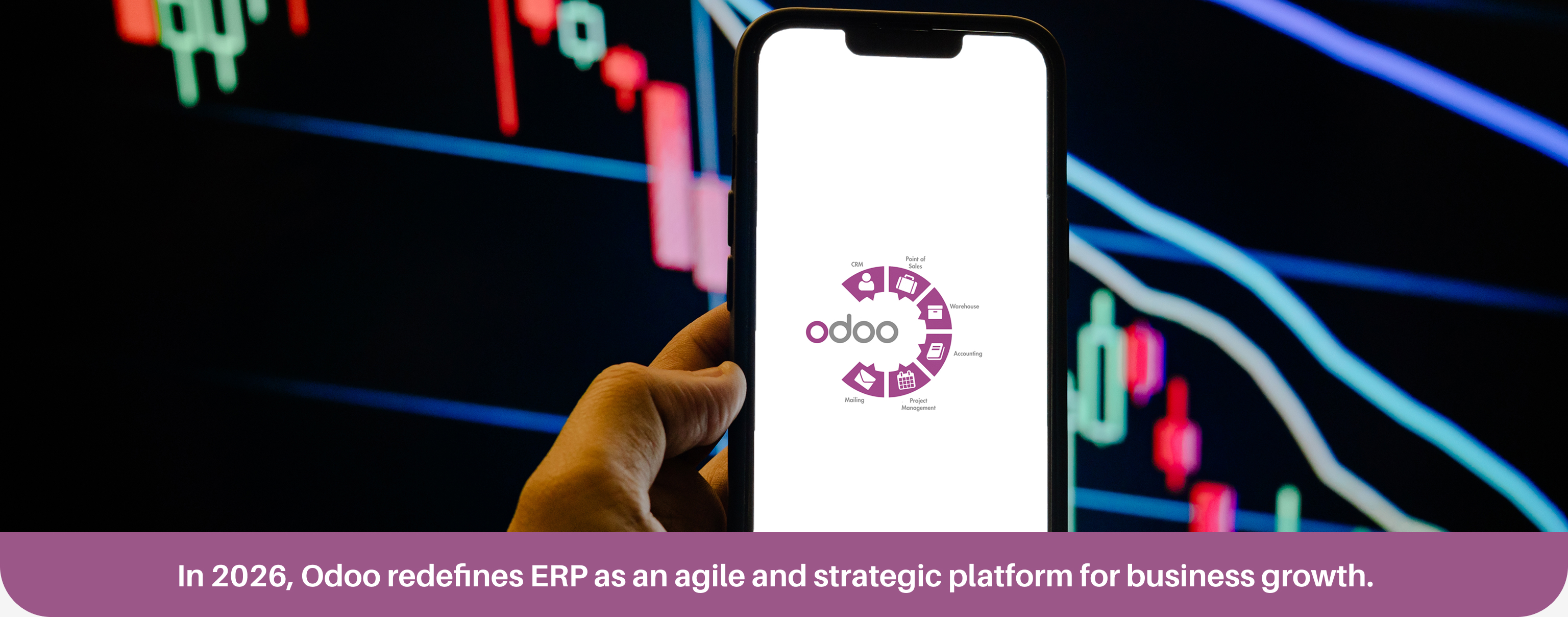
Today, Odoo is no longer perceived only as an economic alternative to other ERPs, but as a strategic platform for companies that seek to organize their operations, gain visibility and scale without losing agility. Its adoption responds to a very specific market need: to have a comprehensive system that accompanies business growth, without becoming an obstacle.
This article delves into why Odoo gained so much relevance in 2026, what real problems it solves within organizations and how it has become a key element for operational efficiency and decision-making.
The new business context that drives Odoo

Companies operating in 2026 face a much more complex environment than in previous years. The pressure to be efficient coexists with the need to adapt quickly to changes in the market, new business models and increasingly informed and demanding customers. In this context, the lack of integration between systems becomes a critical problem.
Many organizations continue to work with isolated tools: one software for sales, another for accounting, spreadsheets for internal control and external solutions for reporting. This fragmented model generates duplication of information, constant errors and an enormous dependence on manual work. In addition, it makes it difficult to have a clear view of the real state of the business.
Odoo emerges as a response to this fragmentation. Its integrated approach allows areas of the company to work on the same platform, sharing information in real time. Not only does this improve operational efficiency, but it changes the way companies understand and manage their information.
What is Odoo in 2026 and why is it no longer “just an ERP”
Defining Odoo in 2026 solely as an ERP falls short. While it fulfills the traditional functions of an enterprise resource planning system, its scope goes much further. Odoo is a business management platform that connects operational, financial and business processes within the same ecosystem.
Its modular architecture allows companies to gradually adopt Odoo. There is no need to implement the entire system from day one. Organizations can start with key modules—such as sales, accounting, or inventory—and incorporate new functionalities as their processes mature and their needs grow.
This approach reduces implementation risk and allows the system to evolve at the pace of the business. Instead of becoming a heavy project, Odoo is progressively integrated into daily operation, facilitating user adoption.
Odoo as a basis for operational efficiency
One of Odoo's greatest assets is its ability to eliminate operational friction. When information flows automatically between areas, processes become simpler and more reliable. This has a direct impact on time, costs and information quality.
For example, a sales order registered on Odoo doesn't just impact the business area. It is automatically reflected in inventories, logistics, billing and accounting. This avoids reprocessing, reduces human errors and allows each area to be clear about its role in the process.
In 2026, operational efficiency isn't just about doing more with less, but about building clear, traceable and sustainable processes. Odoo allows companies to standardize their operation without losing flexibility, which is key in environments of constant growth or change.
Flexibility and adaptability: Odoo's true differentiator
One of the main reasons why Odoo has gained ground compared to other ERPs is its adaptability. Every company operates differently, and pretending that they all fit the same model often generates resistance and frustration.
Odoo allows you to configure flows, rules and processes according to the reality of the business. This is especially valuable for companies that are redefining their operating model, exploring new markets or adjusting their internal structure.
In addition, when standard processes are not sufficient, Odoo offers the possibility of carrying out customized developments in a controlled manner. This allows specific needs to be met without compromising the stability of the system or its upgradability.
Odoo and decision-making based on real information

In a business environment where decisions must be made more and more quickly, having reliable and up-to-date information is a competitive advantage. Odoo centralizes operational and financial data, making it possible to generate reports in real time that reflect the current business situation.
This transforms the way leaders analyze their company. We no longer rely on manually prepared monthly reports or incomplete information. With Odoo, it is possible to monitor key indicators, detect deviations and make more informed decisions.
In 2026, this capacity for continuous analysis becomes essential to anticipate problems, optimize resources and seize opportunities before the competition.
Implementing Odoo as a transformation process, not just for systems
One of the factors that determines the success of Odoo is how its implementation is approached. Companies that see it only as a system change tend to miss out on much of their potential.
Implementing Odoo involves reviewing processes, questioning inherited practices and redefining the way we work. The system acts like a mirror that shows inefficiencies, duplications and areas for improvement. Seizing this opportunity requires a mindset open to change.
When implementation is managed as a transformation process, Odoo becomes an enabler of best practices and not just an operational tool.
Odoo in growing and expanding companies

Growing companies face particular challenges: increased volume, greater operational complexity and the need for control. Often, these challenges are tried to be solved by adding more people or more tools, which in the long term creates disorder and lack of visibility.
Odoo allows you to structure the operation without losing agility. As the company grows, the system can be expanded with new modules, users and processes, maintaining a centralized view of the business.
In 2026, this ability to scale without losing control is one of the main reasons Odoo has become so attractive to midsize and expanding businesses.
The future of Odoo as an enterprise platform

Odoo continues to evolve to respond to new market demands. Its focus on automation, user experience, and integration with other technologies reinforces its position as a future-ready platform.
More than a static system, Odoo behaves like a constantly improving ecosystem, aligned with the changing needs of companies. This continuous evolution is key to ensuring that investment in Odoo continues to generate long-term value.
Conclusion: Odoo as a strategic decision in 2026
Adopting Odoo in 2026 goes far beyond choosing an ERP. It is a strategic decision that directly impacts the way a company operates, grows and makes decisions.
Organizations that use Odoo as the backbone of their management achieve greater efficiency, better visibility and greater adaptability. In an increasingly demanding business environment, these qualities make the difference between simply operating and truly competing.