
Artificial Intelligence in Odoo: How ERPs are evolving into systems that analyze, predict and automate business decisions
In this blog, we will explore how artificial intelligence is transforming ERP systems and turning them into platforms capable of analyzing data, predicting scenarios and automating business decisions. Through the case of Odoo, we will see how the integration of AI allows us to optimize processes, improve customer, inventory and financial management, and help companies make more informed decisions based on data.



For decades, ERP systems were primarily designed to record and organize information. Its main function was to centralize administrative processes, control inventories, manage finances and provide reports that would allow us to understand the state of the company. However, today's business environment requires more than just data organization. Companies need systems that interpret information, identify patterns and help anticipate decisions.
It is precisely in this context that artificial intelligence begins to integrate naturally into ERPs. Instead of just storing information, modern systems are evolving into platforms capable of analyzing operational data and converting it into useful knowledge for the organization.
Odoo, one of the fastest-growing ERP platforms in the business market, is in a particularly interesting position within this evolution. Its modular architecture, open approach and ability to customize allow artificial intelligence tools to be incorporated more flexibly than many traditional systems.
The combination of Odoo and artificial intelligence technologies doesn't just represent a technological improvement. It represents a profound change in the way companies manage their operations, use their data and make strategic decisions.
This article explores how artificial intelligence is transforming the way Odoo works, what real applications it has within organizations and why this combination is becoming one of the pillars of modern business management.
The growth of artificial intelligence within ERPs

The integration of artificial intelligence into business systems is not a passing trend. It is the result of a natural evolution driven by three main factors: the exponential growth of business data, the need to automate processes and the pressure to improve the quality of decision-making.
Companies today generate more information than ever before. Every transaction, interaction with customers, inventory movement or financial process generates data that, properly analyzed, can provide valuable information about the operation of the business.
However, in many cases this information remains underused. Traditional systems can store data and generate reports, but they don't necessarily interpret them or anticipate future scenarios.
Artificial intelligence can close this gap. By applying machine learning algorithms and predictive analysis to data stored in the ERP, organizations can discover patterns, detect anomalies and obtain automatic recommendations.
Several studies show that the adoption of artificial intelligence within ERP systems is growing rapidly. According to recent statistics, more than 70% of ERP providers have already incorporated artificial intelligence functionalities into their solutions, and this figure is expected to continue to rise over the next few years.
This change reflects a fundamental transformation in business software: ERPs are evolving from record systems to intelligent business management platforms.
Why artificial intelligence needs to integrate with ERP
Many companies have started experimenting with artificial intelligence through isolated tools: data analysis platforms, virtual assistants or independent automation solutions. Although these initiatives can generate benefits, they often face a significant limitation: limited access to operational business information.
Artificial intelligence can only generate useful results when it has access to complete, structured and reliable data. In most organizations, that data is located inside the ERP.
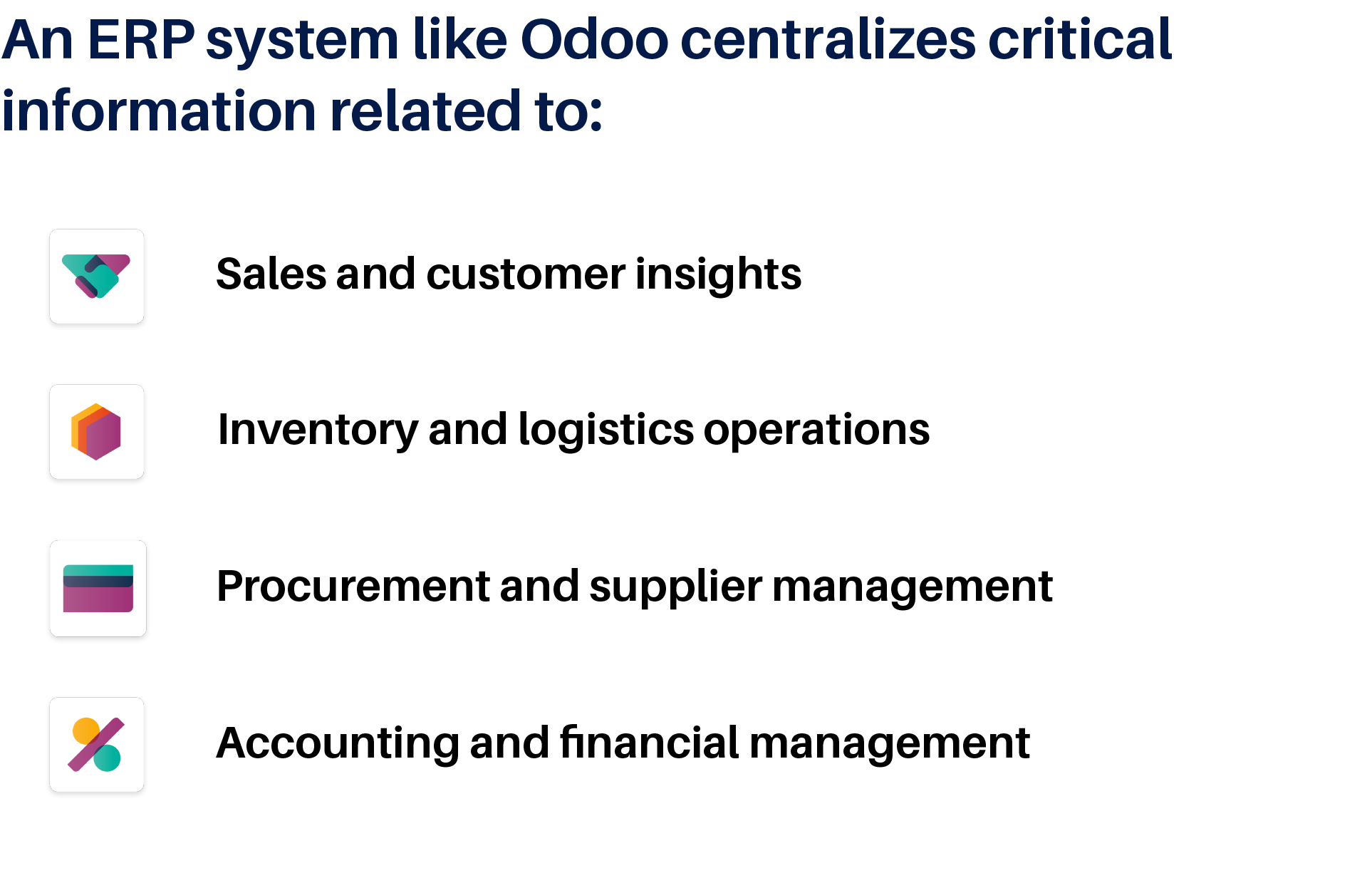
When artificial intelligence is directly connected to this information, it becomes possible to analyze the entire operation of the business, not just isolated fragments. This opens the door to a new model of business management, where the system not only records what happened, but also helps to understand Why did it happen and what could happen next.
How artificial intelligence works inside Odoo
The integration of artificial intelligence into Odoo can take multiple forms, depending on the needs of the organization and the company's level of technological maturity.
In some cases, artificial intelligence is used to automate repetitive operational tasks. In others, it is used to analyze large volumes of data and generate strategic recommendations.
One of the most interesting features of Odoo is its ability to integrate artificial intelligence tools both within its standard modules and through custom developments or external integrations.
This means that artificial intelligence can be applied in different areas of the system, from customer management to financial analysis or inventory planning.
Instead of being an isolated function, artificial intelligence becomes a layer of intelligence that goes through multiple processes within the organization.
Artificial intelligence applied to CRM and customer management

One of the fields where artificial intelligence has the greatest impact within Odoo is the management of customers and business opportunities.
CRM systems store large amounts of information about customer interactions, purchase history, browsing behavior, and commercial campaign performance. When this data is analyzed using artificial intelligence algorithms, patterns can be identified that help improve business strategy.
For example, artificial intelligence can analyze historical data to identify which types of customers are most likely to convert into sales. It can also detect business opportunities that require priority attention or suggest specific actions to increase the likelihood of closing.
In addition, artificial intelligence systems can help automate tasks within the CRM, such as classifying leads, assigning opportunities to sellers, or generating initial responses to customer inquiries.
This type of automation doesn't replace human labor, but it does allow business teams to focus on higher-value activities, such as negotiating or building relationships with customers.
Artificial intelligence in inventory management and logistics

Inventory management is another field where artificial intelligence can generate significant benefits within Odoo.
One of the main challenges in inventory management is finding the right balance between product availability and storage costs. Having too much inventory can create unnecessary costs, while having too little can lead to shortages and lost sales.
Artificial intelligence algorithms can analyze historical demand patterns, market trends, and customer behavior to generate more accurate predictions about future demand.
These predictions make it possible to optimize inventory levels, improve purchase planning and reduce operational risks.
In companies that manage large volumes of products or complex supply chains, this type of analysis can generate significant improvements in efficiency and profitability.
Artificial intelligence applied to financial analysis
Financial areas also benefit from the integration of artificial intelligence within Odoo.
Accounting systems generate large volumes of information related to revenues, expenses, operating costs, and financial performance. Analyzing this data manually can be complex and time consuming.
Artificial intelligence can identify financial patterns, detect anomalies and generate predictive analyses that help to anticipate problems or identify opportunities for optimization.
For example, algorithms can detect budget deviations, analyze spending trends, or identify customers with a higher risk of delinquency.
In addition, by combining financial data with operational information from the ERP, more complete analysis models can be generated that connect business activity with financial results.
Intelligent business process automation
One of the most immediate benefits of integrating artificial intelligence within Odoo is intelligent process automation.
Many tasks within an organization are repetitive and consume valuable time for work teams. Processing documents, classifying information, validating data or generating reports are necessary but not very strategic activities.
Artificial intelligence makes it possible to automate these types of processes, reducing human errors and freeing up time for more strategic activities.
For example, systems can automatically analyze documents, classify invoices, or detect inconsistencies in accounting records.
This type of automation not only improves operational efficiency, but also increases the reliability of information within the system.
The impact of artificial intelligence on business productivity

The adoption of artificial intelligence within ERP systems is having a significant impact on the productivity of organizations.
Several studies show that companies that integrate artificial intelligence into their management systems experience improvements in operational efficiency, reduction of errors and greater speed in decision-making.
The main reason is that artificial intelligence allows large volumes of information to be processed in real time, something that would be impossible for human teams.
This does not mean that technology replaces human judgment, but rather that it acts as a complement that allows us to make better informed decisions.
Instead of relying solely on intuition or experience, business leaders can rely on data-driven analysis to define strategies and evaluate scenarios.
The challenges of implementing artificial intelligence in Odoo
Despite its benefits, implementing artificial intelligence within an ERP also presents challenges.
One of the main ones is data quality. Artificial intelligence algorithms rely on accurate and well-structured information. If the data within the ERP is incomplete or inconsistent, the results generated by artificial intelligence can be unreliable.
Another challenge is technological integration. Although Odoo is a flexible platform, integrating artificial intelligence solutions requires technical knowledge and a clear strategy for how to use system information.
For this reason, many organizations choose to work with specialized consultants who can design artificial intelligence solutions aligned with their business processes.
The future of artificial intelligence within Odoo
The evolution of Odoo and of business software in general suggests that artificial intelligence will play an increasingly important role in management systems.
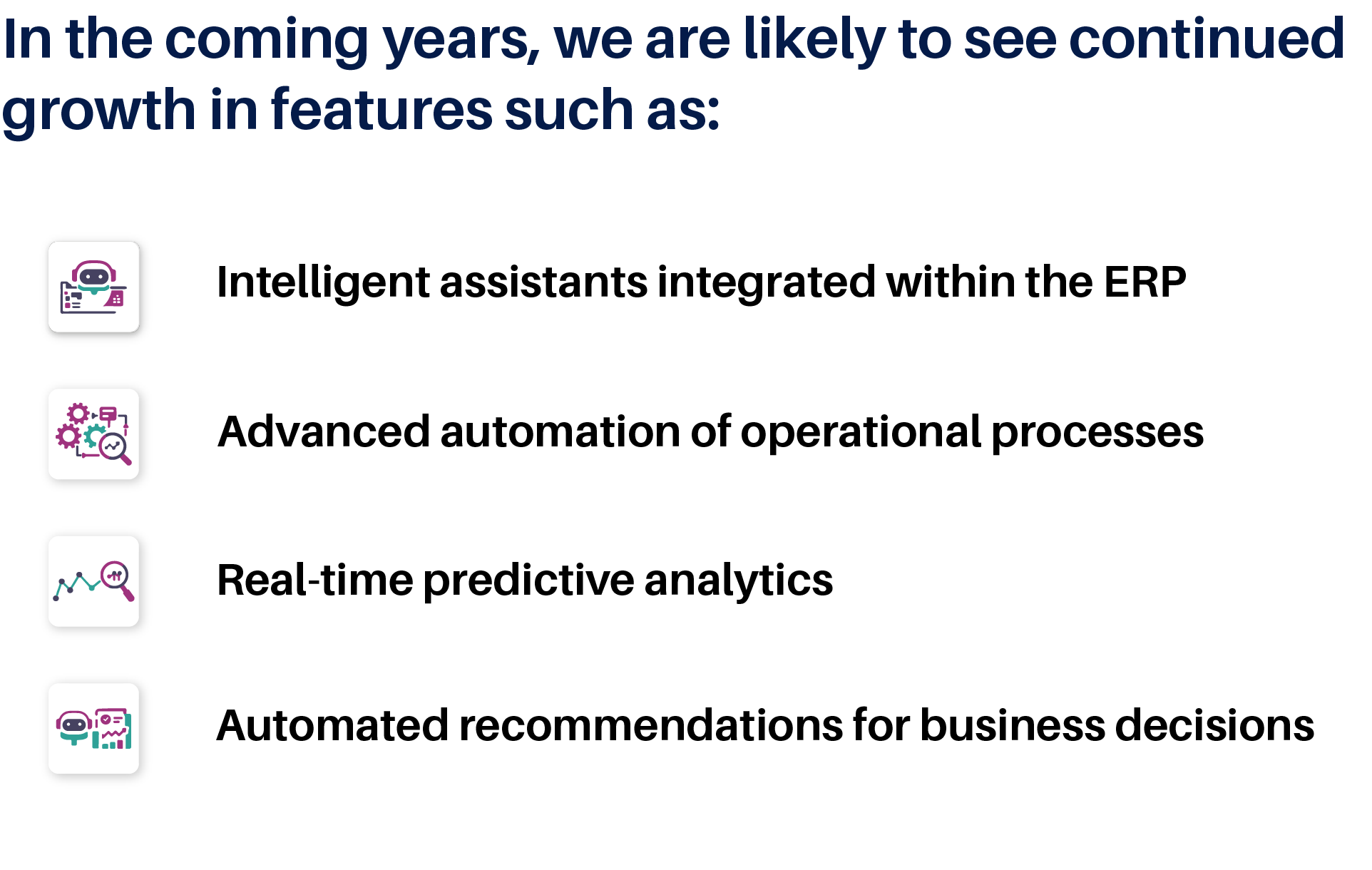
These capabilities will gradually transform the role of ERP within organizations, going from being an administrative system to becoming a business intelligence platform.
Conclusion
The integration of artificial intelligence into Odoo represents an important evolution in the way companies manage their information and processes.
By combining the organizational capacity of an ERP with the analytical power of artificial intelligence, organizations can transform their data into useful knowledge and make more informed decisions.
In an increasingly competitive business environment, where speed of adaptation and quality of information are key factors, this combination can become a significant strategic advantage.
Companies that begin to explore these possibilities will not only be modernizing their technology. They will be building a stronger foundation to compete in a future where business intelligence will be increasingly important.