From Excel to Odoo: the leap that SMEs must take to grow
In this blog you will find out why Excel has been a key tool for SMEs, but also when it stops being enough. We explain the signs that your company has outgrown spreadsheets, the risks of continuing to operate like this and how Odoo can help you integrate processes, improve control and grow in an orderly manner.
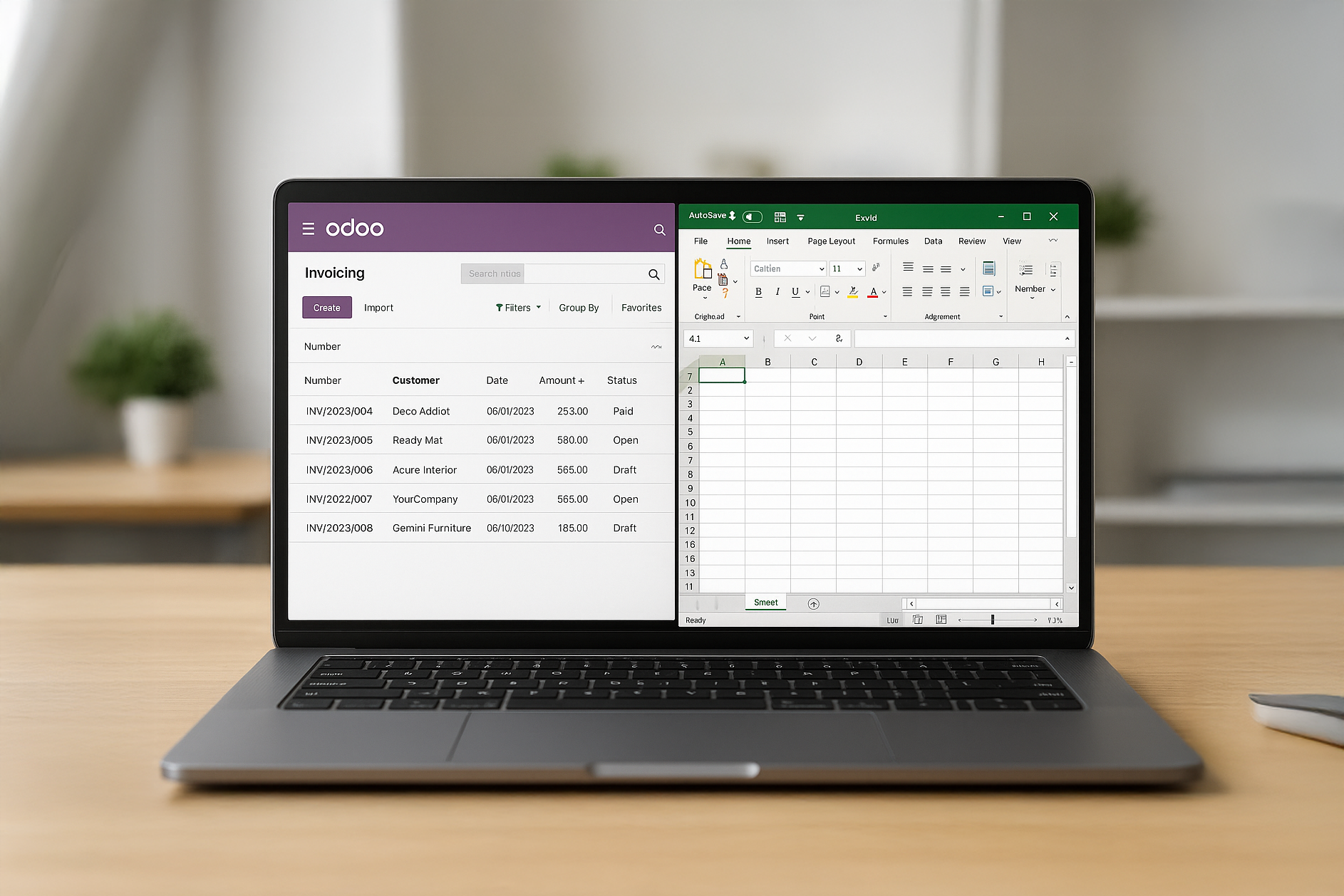

For years, Excel has been the great ally of small and medium-sized companies. Its flexibility, ease of use and low cost made it the preferred tool for managing inventories, keeping track of sales, recording expenses or preparing reports. However, as businesses grow, what once seemed sufficient is starting to fall short. Files become unmanageable, errors multiply, and critical information is scattered across multiple spreadsheets.
At this point, many SMEs face a crucial decision: to continue to rely on Excel sheets that no longer support the complexity of their operations, or to make the leap to a more robust system that accompanies their growth. This natural evolution is called Odoo, a modular and scalable ERP that integrates all areas of the business on a single platform.
In this article, we will analyze why so many companies are stuck in Excel, what signs show that it's time to migrate to something more advanced, and how Odoo can become the strategic ally for achieving efficiency, control and scalability.
The role of Excel in SMEs
Before criticizing it, we must recognize the importance of Excel in the business world. It's a versatile, accessible, and powerful tool for data analysis. For an early-stage SME, it's logical and practical to start with spreadsheets: they allow you to record movements, consolidate information and make calculations without the need for a large investment in specialized software.
Many entrepreneurs have built their first processes with Excel: from controlling warehouse entries and exits, to preparing manual invoices or following up with customers. The problem isn't using Excel, but converting it into the central management system of the company.
As the organization grows and handles more transactions, more customers and more areas, the limits of Excel become evident:
- Duplication of data.
- Files that are lost or corrupted.
- Difficulty working as a team.
- Capture errors that go unnoticed.
- Processes that require hours of manual labor.
Excel is great as a support tool, but when used as the backbone of the business, it ends up holding back more than it helps.
Signs that your company has already “outdone” Excel
Not all companies are on the same page. But there are certain signs that an SME should already consider a transition to an ERP like Odoo:

If you recognize several of these points in your company, it means that Excel is no longer enough and that you need to take a step towards something more robust.
Why is Odoo natural evolution?
The transition from Excel to Odoo is not a leap to the void, but a logical evolution. Odoo is a business management system (ERP) that integrates into a single platform the main areas of the company: sales, purchases, inventory, accounting, human resources, marketing, e-commerce, and many others.
What makes Odoo different is its modular nature. You don't need to implement everything all at once, you can start with the modules that solve the most pressing problems and, as your business grows, add new features.
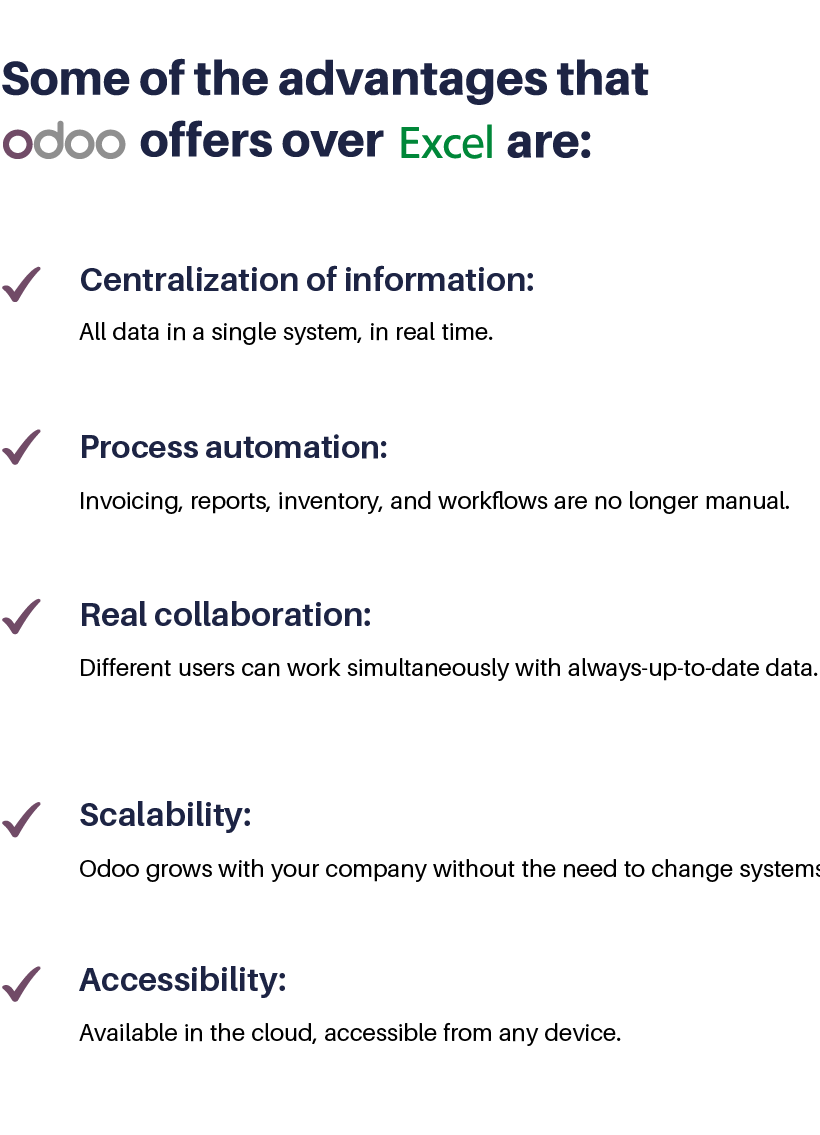
With Odoo, what was once a tangle of scattered files becomes an orderly, secure and easy to manage system.
Concrete benefits for SMEs that take the leap
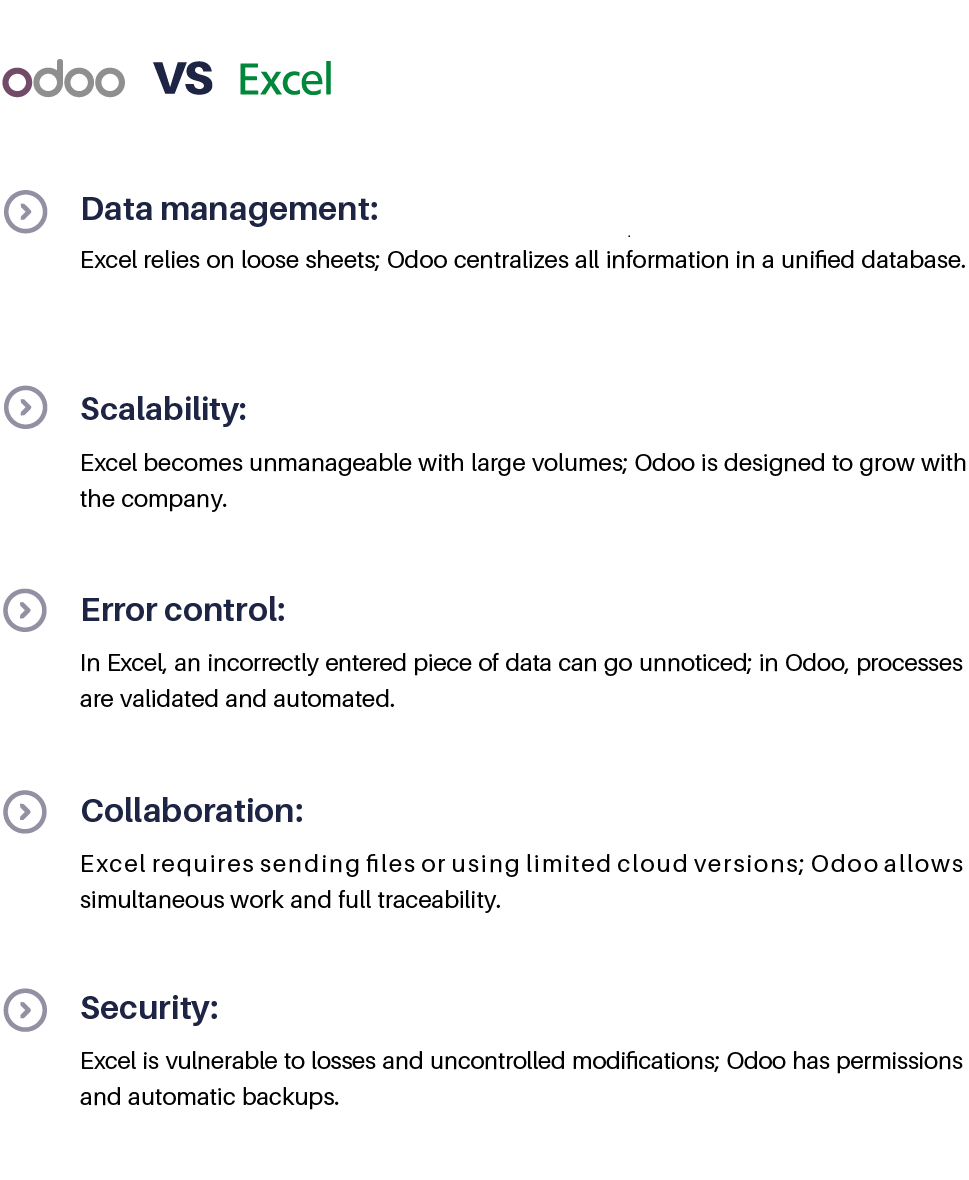
Migrating from Excel to Odoo isn't just a technological change, it's a transformation in the way we work. Some of the most notable benefits for SMEs are:
Productivity. Less time spent on repetitive tasks and more focus on strategic activities.
Data-based decisions. Real-time reports with reliable information.
Orderly growth. Odoo allows you to incorporate new functions without disrupting the operation.
Reduction of hidden costs. Man hours spent on manual captures are reduced and costly errors are avoided.
Better customer experience. More agile processes and fewer failures impact better service.
Practical examples: when taking the leap makes a difference
To land it, let's look at fictional examples inspired by real cases:
A food distributor. With Excel, I kept inventories on separate sheets per warehouse. Capture errors caused constant shortages and dissatisfied customers. After migrating to Odoo, he centralized inventory in real time, reduced losses and was able to better plan his purchases.
A professional services company. I used Excel to record billable hours. With multiple consultants, reporting was slow and inaccurate. Odoo allowed him to control projects, hours and billing automatically, improving his cash flow.
A growing e-commerce. In the beginning, it was enough to record orders in spreadsheets. But with more than 200 orders a day, the chaos became unmanageable. With Odoo, he integrated his online store with inventory, billing and logistics, managing to fulfill more orders with fewer errors.
These examples show that the transition is not just a “software change”, but a real competitive advantage.
Common myths about migrating from Excel to an ERP
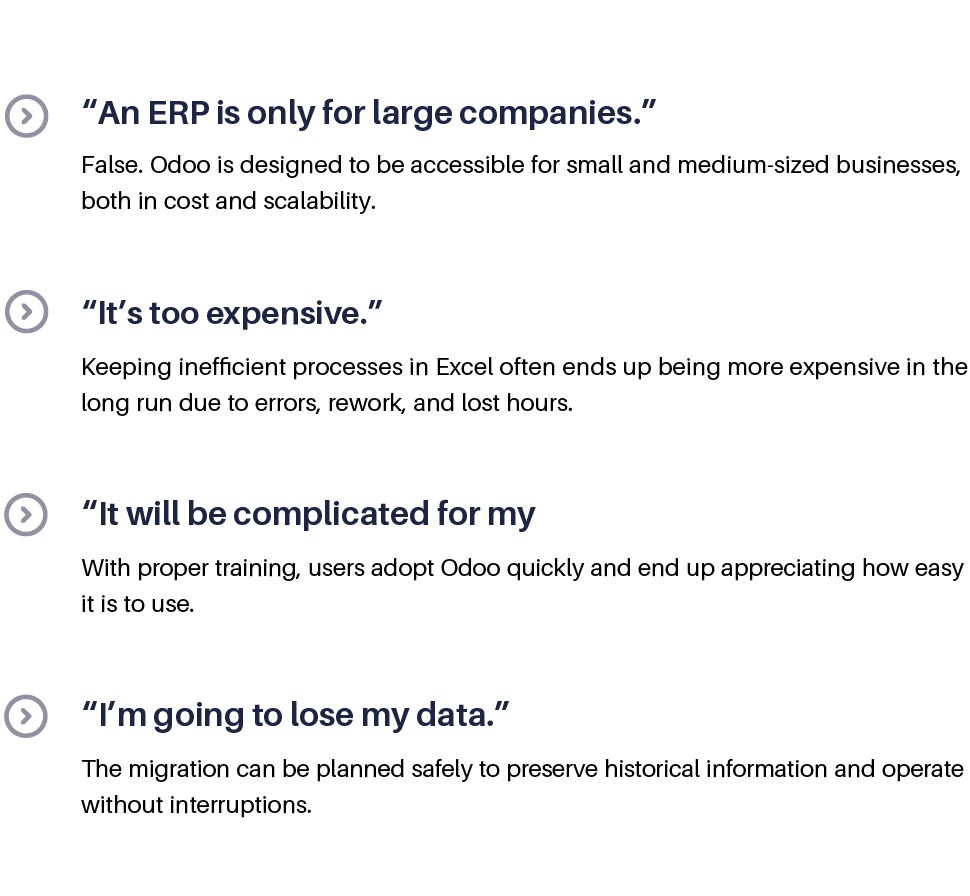
Many SMEs postpone the change because they believe in certain myths:
Recommendations for safe adoption
Migrating from Excel to Odoo doesn't have to be traumatic. These recommendations help make it more fluid:
- Start small. Don't try to implement all the modules at once, prioritize the ones that solve your biggest pain.
- Involve the team. Get users involved in tests and pilots right from the start.
- Train in a practical way. Resistance decreases when people see how the tool makes their work easier.
- Measure results. Define clear success metrics, such as reduced errors or processing times.
- Lean on experts. A good implementation partner can make the difference between success and failure.
Conclusion
Excel will continue to be a valuable tool for analysis and calculations, but it cannot remain the heart of a growing company. SMEs that insist on sustaining their operations with spreadsheets risk being left behind in the face of more agile competitors.
Making the leap to Odoo means adopting a system that not only organizes information, but also enhances productivity, improves collaboration and prepares the company for sustainable growth.