
Data-driven doesn't mean data-intelligent: why your data isn't helping your business
In this blog, you'll discover why having more data doesn't necessarily improve your decisions and how excess information can be causing confusion in your business.



Over the past few years, companies have invested significant amounts of money, time and effort in analysis tools, Business Intelligence platforms, real-time dashboards and management systems that promise greater business visibility. The promise was clear: if you have more data, you'll make better decisions.
The concept of “data-driven” ceased to be a trend and became an expectation. Today, any organization that doesn't use data to make decisions is perceived as lagging behind. However, in 2026, many companies are facing an uncomfortable and under-discussed reality: Having more data isn't necessarily improving your decisions; in many cases, it's making them worse.
This phenomenon is not obvious to the naked eye. In fact, it's quite quiet. Companies continue to operate, generating reports, reviewing indicators and making decisions with apparent analytical support. But when you look at the results—inefficiencies, poor decisions, operational weight—a key question emerges:
Is data really helping... or is it confusing?
This article does not seek to discredit data use. On the contrary, it starts from the premise that data is essential. But it raises something deeper: the problem is not the lack of information, but the way in which companies are interpreting and using that information.
The “data-driven” myth: when having data becomes an illusion of control

For years, business discourse has driven the idea that organizations must be “data-driven”. In theory, this involves making informed decisions, based on evidence and not just on intuition. However, in practice, many companies interpreted this concept superficially.
Being data-driven isn't about having dashboards. It's not measuring everything. It's not accumulating information.
The problem is that many organizations confused the medium with the objective. They implemented tools, generated reports and began to measure every aspect of their operation without questioning whether they really understood what they were seeing.
This gave rise to a paradoxical situation: companies with more visibility than ever... but with less clarity.
Access to mass information creates a sense of control. But that control is often an illusion. Seeing data doesn't mean understanding it, and understanding it doesn't guarantee better decisions.
When dashboards stop being tools and become a distraction

One of the most representative elements of this problem is the excessive use of dashboards. In practically all modern organizations, there are control panels that show key indicators in real time: daily sales, conversions, productivity, inventories, costs, margins, and others.
In theory, these dashboards should facilitate decision-making. But in practice, they often have the opposite effect.
Why? Because teams are starting to focus on the indicator, not the problem.
A dashboard can show that sales were down 8% in one week. But that number alone doesn't explain anything. It doesn't say if it's a seasonal pattern, a business problem, a failure in the operation, or even a strategic decision.
Without context, dashboards elicit immediate reactions. Meetings are called, teams are pressured, decisions are made quickly... often without understanding what is really going on.
This creates a reactive environment, where the company lives responding to numbers instead of analyzing the business.
The obsession to measure everything: when more information generates less clarity
Another phenomenon that has become common is the need to measure absolutely everything. Each area generates its own indicators, each team defines metrics and each tool provides new data.
At first glance, this seems positive. But in reality it creates a critical problem: information overload.
When a company has too many indicators, it loses the ability to distinguish what is important from what is irrelevant. All the numbers seem to carry the same weight, and this dilutes the strategic approach.
In addition, not all indicators have the same impact on the business. Some reflect results, others show only activity. Some are predictive, others are historical. Some are strategic, others operational.
When this differentiation is not made, decisions become chaotic.
Instead of responding to what really matters, companies begin to react to any variation, regardless of its relevance.
Data without context: the real source of wrong decisions

One of the most common errors in using data is analyzing it in isolation. A number, by itself, has no meaning. It needs to be interpreted within a context.
For example, an increase in sales may seem positive. But if that growth is accompanied by a disproportionate increase in costs, the financial result could be negative.
In the same way, a decrease in productivity may not be a problem if it is related to an operational transition or an improvement in the quality of work.
Context is what gives meaning to data.
Without it, companies make decisions based on incomplete interpretations. And these decisions, while well-intentioned, often have negative effects.
Automation without judgment: when technology amplifies errors

Automation and artificial intelligence have allowed many companies to operate more efficiently. However, they have also introduced a new risk: automating incorrect decisions.
When a company defines rules based on misinterpreted indicators, and then automates those rules, the problem escalates.
For example, if a system is configured to reduce marketing investment every time conversion drops, but the context (season, market, external changes) is not considered, the company could be making harmful decisions automatically.
Technology doesn't correct logical errors. It only executes them faster.
The silent impact on the operation
Misuse of data doesn't always translate into an obvious problem. It's not a mistake to stop the operation right away. It's something more subtle, but more dangerous.
It is manifested in:
- Decisions that don't generate results
- Teams that work more but make less progress
- Constant changes without clear direction
- Operational frustration
- Organizational wear and tear
Companies start to sen
Companies start to feel that something isn't working, but they can't identify exactly what it is.
And many times, the problem is in the way they are using their data.
The role of integrated systems: clarity vs fragmentation

Another factor that influences this problem is the fragmentation of information. Many companies operate with multiple systems that are not integrated with each other.
This causes inconsistencies, duplication of data and difficulty obtaining a complete view of the business.
This is where platforms like Odoo take on relevance. By centralizing information in a single system, they allow for more consistent and reliable data.
But it's important to understand something:
having an integrated system does not solve the problem if the information is not interpreted correctly.
Technology makes it easier, but it doesn't replace analysis.
What do companies that understand their data do differently
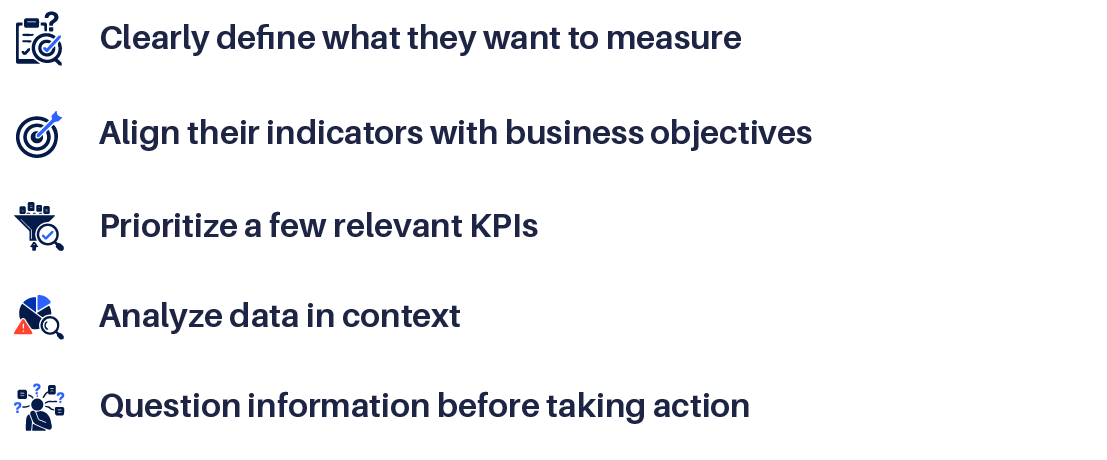
Companies that really take advantage of your data don't necessarily have more information. They have better judgment.
These organizations:
From Data-Driven to Data-Intelligent: The Real Change
In 2026, the concept of “data-driven” is evolving into something more profound: Data-intelligent.
It's not just about using data, it's about understanding it.
This involves:

Companies that succeed in making this change will have a real competitive advantage.
Conclusion: More data isn't the solution, it's part of the problem
Access to data is no longer an advantage. It's a basic condition.
What really sets companies apart is their ability to turn that data into right decisions.
And to do that, they don't need more information. They need more clarity.
Because in 2026, the problem isn't a lack of data...
The thing is that many companies still don't know what to do with them.